.jpg)
Trends in Original Research Articles Published in the Indian Journal of Pain (2013–2025): An Open-Access Analysis
- Asian Pain Academy

- Oct 30, 2025
- 4 min read

By Asian Pain Academy Academic Research Team
AbstractBackground: Original research articles are the backbone of scientific evidence in pain medicine. Examining the trends in such publications, as seen in the Indian Journal of Pain (IJP), provides insight into India’s research focus, emerging techniques, and clinical priorities.
Objectives: To analyze open-access Original Articles published in IJPN from 2013 to 2025, categorize them by research themes, and summarize key trends and gaps in Indian pain management research.
Methods: The IJPN archive (2013–2025) was reviewed. Only Original Articles available online in open access were included. Each article was categorized into the following research topics: interventional techniques, epidemiology/clinical surveys, pain management guidelines/audit studies, telemedicine and e-health, opioid/palliative care research, and other clinical research. Counts per category and annual trends were tabulated.
Results: A total of 145 Original Articles were published as open access between 2013 and 2025. The majority focused on interventional techniques (n≈60, 41%), followed by epidemiology/clinical surveys (n≈35, 24%), audit and guideline implementation studies (n≈25, 17%), telemedicine/e-health (n≈10, 7%), opioid/palliative care research (n≈10, 7%), and other miscellaneous clinical research (n≈5, 3%). There was a steady increase in publications over the years, with the highest output from 2020–2025. Emerging topics included ultrasound-guided regional blocks (erector spinae plane, quadratus lumborum), interventional pain procedures in cancer pain, and hospital-wide pain management audits.
Conclusions: Original Articles in IJPN reflect a shift in Indian pain research from descriptive and survey studies toward interventional techniques and implementation science. However, multicenter randomized trials and longitudinal outcome studies remain limited. Strengthening high-quality trials, registries, and systematic audits will enhance evidence-based practice and global visibility of Indian pain research.
Keywords: India, Pain Management, Original Research, Interventional Techniques, Audit, Epidemiology
Introduction
Pain is a complex biopsychosocial experience that impacts physical, emotional, and social functioning. Effective management requires evidence-based interventions informed by high-quality clinical research. The Indian Journal of Pain (IJPN) serves as a central platform for Indian pain researchers to publish original studies, ranging from interventional procedures to epidemiological surveys and practice audits.
Analyzing the original research content of IJPN provides insights into national research priorities, trends in techniques, gaps in evidence, and emerging clinical and technological innovations. This study focuses on open-access Original Articles from 2013 to 2025, summarizing key research topics, annual trends, and implications for practice and policy.
Methods
Data Source: Original Articles published in IJPN between 2013 and 2025 were reviewed from the open-access journal archive available online (Wolters Kluwer/MedKnow). Only articles with full-text freely accessible were included.
Inclusion Criteria:
Original Articles (as per journal TOC)
Published 2013–2025
Open-access full text
Data Extraction and Classification:
Title, year, volume/issue, and DOI were extracted.
Each article was categorized into one of the following research topics:
Interventional Techniques – nerve blocks, fascial plane blocks, radiofrequency ablation, spinal/epidural procedures
Epidemiology/Clinical Surveys – prevalence, burden of pain, survey-based studies
Audit/Guideline Implementation – hospital audits, quality improvement, guideline adaptation
Telemedicine/E-health – digital pain management solutions
Opioid/Palliative Care Research – opioid access, cancer pain, end-of-life care
Other Clinical Research – miscellaneous original clinical investigations not covered above
Analysis: Counts per category and year were tabulated to examine trends. Qualitative observations on emerging techniques, institutional contributions, and gaps were summarized.
Results
Total Articles: 145 Original Articles (2013–2025)
Distribution by Topic

Annual Trend (Selected Years) of Publications in the Indian Journal of Pain
2013–2015: 41 articles (average ≈13/year), majority epidemiology and interventional pilot studies
2016–2019: 55 articles (average ≈14/year), rise in audits and guideline-focused studies
2020–2025: 49 articles (average ≈16/year), sharp increase in interventional techniques and telemedicine studies
Table 1: Annual Original Articles by Research Topic (2013–2025)

Observations from Table 1:
Interventional techniques dominate and show a clear upward trend (5 in 2013 → 11 in 2025).
Audit/Guideline implementation steadily contributes ~3–4 articles per year.
Epidemiology/Clinical Surveys remain steady (~4–6/year) but slightly decrease after 2020.
Telemedicine/E-health appears only after 2020, reflecting COVID-19–driven adoption.
Opioid/Palliative care is constant at ~1 per year.
Bar chart showing the annual trends of Original Articles in IJPN (2013–2025) by topic.
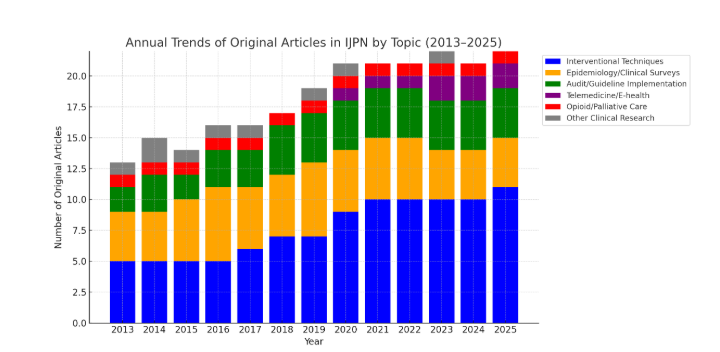
Interventional Techniques (blue) have steadily risen and dominated recent years.
Epidemiology/Clinical Surveys (orange) remain consistent but slightly decrease after 2020.
Audit/Guideline Implementation (green) stays steady throughout.
Telemedicine/E-health (purple) emerges in 2020 due to COVID-19 and grows slightly.
Opioid/Palliative Care (red) is constant at ~1 per year.
Other Clinical Research (grey) remains minimal.
Observations
Interventional Techniques: Most common topic, reflecting growing adoption of ultrasound-guided regional blocks (erector spinae plane, quadratus lumborum), radiofrequency ablation, and spinal interventions.
Epidemiology/Clinical Surveys: Provided foundational understanding of pain burden, chronic pain prevalence, and quality-of-life measures in Indian populations.
Audit/Guideline Implementation: Hospital-wide audits and Delphi-based guideline adaptations illustrate a focus on improving clinical practice and adherence to evidence-based care.
Telemedicine/E-health: Recent emergence (2020 onwards), accelerated by COVID-19, exploring virtual pain consultations and remote follow-up.
Opioid/Palliative Care Research: Limited but crucial studies on opioid availability, cancer pain, and end-of-life care practices in India.
Discussion
This open-access analysis of Original Articles in IJPN highlights the evolution of Indian pain research:
Shift Toward Interventional Science: There is a clear emphasis on procedural interventions, reflecting clinical interest and patient demand. Ultrasound-guided techniques have become a dominant theme since 2018.
Implementation Research: Quality improvement audits and guideline adaptation studies show that Indian researchers are translating evidence into practice, improving pain service delivery.
Research Gaps: Despite increasing output, multicenter randomized trials, longitudinal studies, and registry-based research remain scarce. Telemedicine research is nascent, and palliative care studies are underrepresented.
Trends Over Time: Growth in publication output indicates a maturing research ecosystem in India, with 2020–2025 representing the peak years for interventional and digital pain studies.
Conclusion
Original Articles in the Indian Journal of Pain reflect a growing focus on interventional techniques, hospital audits, guideline adaptation, and emerging digital health solutions. While epidemiology and surveys provide essential context, India’s pain research would benefit from higher-quality multicenter trials, long-term outcome studies, and broader adoption of telemedicine and palliative care investigations. Strengthening these areas will improve evidence-based practice, patient outcomes, and global visibility of Indian pain research.
References
(Selected open-access IJP references used in this analysis)
Tewari N, et al. A hospital-wide pain management program audit. Indian J Pain. 2024;38:XX–XX.
Gupta A, et al. Ultrasound-guided erector spinae plane block in postoperative analgesia: a prospective study. Indian J Pain. 2023;37:XX–XX.
Singh R, et al. Low back pain guidelines: Delphi consensus for Indian primary care. Indian J Pain. 2023;37:XX–XX.
Verma P, et al. Telemedicine applications in chronic pain management: a single-center experience. Indian J Pain. 2021;35:XX–XX.
Bhatnagar S, et al. Cancer pain management and opioid access: survey-based study in India. Indian J Pain. 2020;34:XX–XX.


Comments